
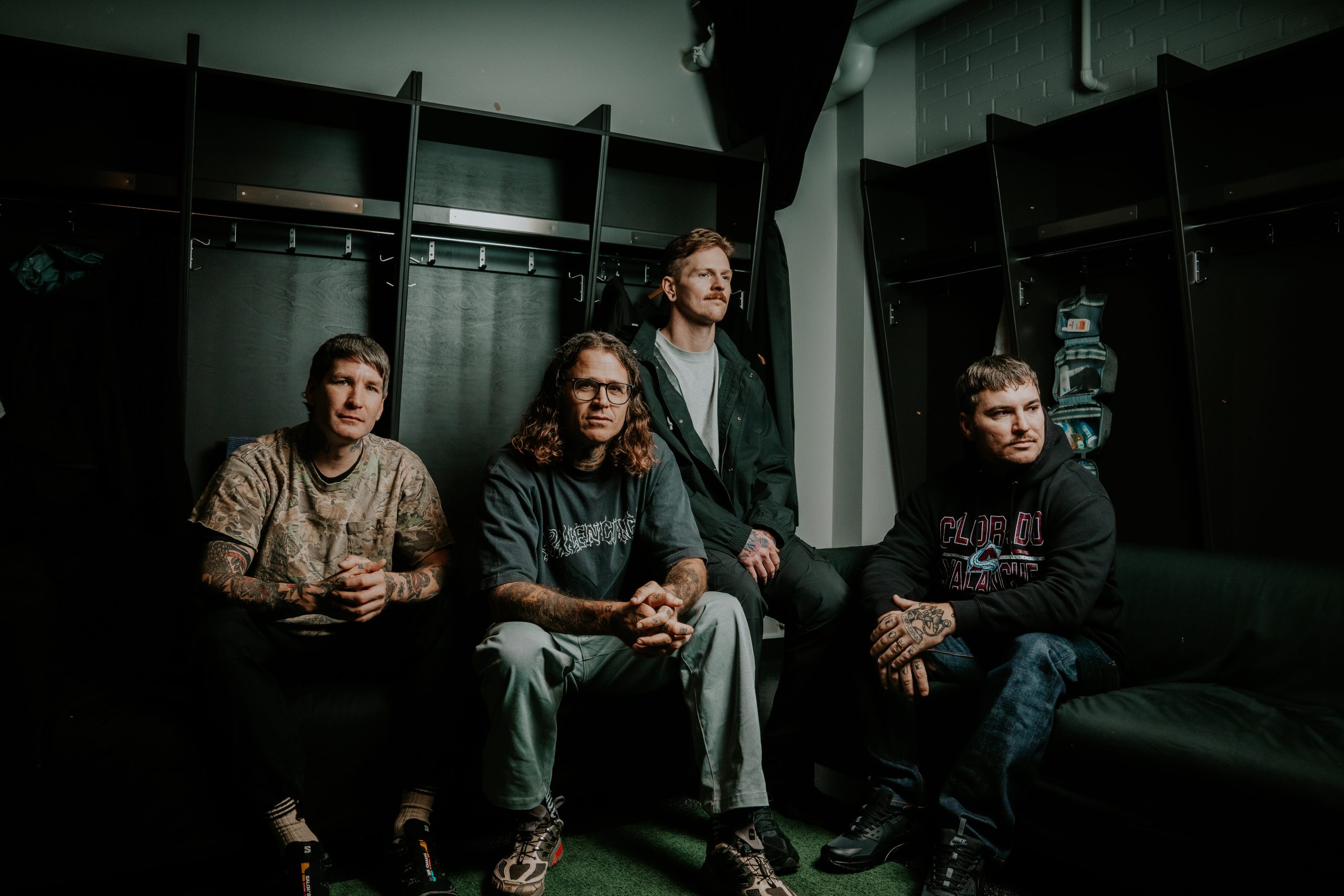
The Amity Affliction didn’t choose emotional honesty as an affectation. It’s pure survival. The Australian melodic metalcore mavericks built a global following through passion, authenticity, and unflinching self-reflection. It’s all powered by massive, heavy compositions anchored in soaring melodicism and unmistakable emotional depth.
These songs don’t promise absolution but recognition. It’s an electric conduit between band and audience, an understanding of suicidal ideation, grief, addiction, and rage. The Amity Affliction is a shared experience, a means of cathartic exorcism and stark clarity.
In the short few years since Not Without My Ghosts (2023), frontman Joel Birch lost a close friend to cancer; his mother passed after a lifetime of abuse and neglect; and he nearly exited the group. The band also faced online discourse after a lineup change.
Birch, longtime guitarist and producer Dan Brown, drummer Joe Longobardi, and new bassist/vocalist Jonathan Reeves drew closer and channeled it all into their art.
House of Cards is a bombastic manifestation of the adage, “If you’re going through hell, keep going.” Despite the turmoil, or perhaps because of it, of life-changing obstacles, The Amity Affliction are more comfortable in their own skin than ever. House of Cards is explosive, defiant, and destined to stand as a new landmark among the band’s catalog.
Anthems like “Pittsburgh” (RIAA-certified Gold in 2025), “Drag the Lake,” “Don’t Lean On Me,” “Soak Me in Bleach,” “Ivy (Doomsday),” and “Open Letter” helped define the band’s legacy. These weren’t crossover hits built for radio; they were lifelines for those who heard their own battles reflected without judgment. As Birch himself says, “I think people can tell when you’re being honest, even if it’s ugly. Especially if it’s ugly.”
The band’s sophomore album, Youngbloods (2010), was named Blunt Magazine’s Album of the Year and earned the band its first of more than half a dozen ARIA Award nominations (and counting). Chasing Ghosts (2012), a viscerally direct admonition against taking one’s own life, became their first No. 1 and first Gold album in Australia.
The band’s popularity grew organically, and they became a staple of the Vans Warped Tour and alternative/metal subculture. Then Let the Ocean Take Me (2014) was a revelation. By the time the band celebrated its tenth anniversary with a massive tour and Redux, Let the Ocean Take Me was revered as a modern classic. It’s a cornerstone of a vibrant scene that, at its best, values honesty and integrity as much as aggression.
Like many bands in the wake of a defining landmark, The Amity Affliction grappled with the weight of expectations while challenging themselves and their audience creatively. Misery (2018) was an adventurous departure that, while catchy and strong, struggled to escape the shadow of its predecessor. As Birch later reflected: “When you start questioning what you’re good at, you make decisions out of fear instead of instinct.”
The next era wasn’t a retreat but a recalibration. Produced by Matt Squire (Panic! At The Disco, The Used, Neck Deep), Everyone Loves You… Once You Leave Them (2020) engaged the band’s heaviest side without abandoning its more recent melodic highs.
The self-produced Not Without My Ghosts (2023) inspired Wall Of Sound to declare, “[The] album will most definitely leave the haters and naysayers taking back every bad word they ever said… Not only do The Amity Affliction still have what it takes, but this album will stand up strong amongst the best in their back catalog for years to come.”
At the heart of Amity’s identity is Birch’s voice — not just as a vocalist, but as a writer whose lyrics have always drawn from lived experience rather than abstraction. From the beginning, his approach was less about confession than confrontation: naming the feelings most people are trained to hide. It made the band a touchstone for listeners navigating mental anguish, loss, and self-destruction — not as spectacle, but as reality.
Birch has spoken openly about addiction in the past, but what defines this period is not recovery mythology or redemption arcs. It’s clarity. “I know, without a doubt, that if I drink again, I will end my life,” he says plainly. “So, there’s no version of this where I get to pretend it’s optional.” A decade of sobriety, for Birch, isn’t an identity or a victory lap. It’s maintenance — the cost of staying alive and present enough to keep going.
That clarity extended beyond drinking (or gambling). Over time, Birch began shrinking his world down to what he could control. He stepped away from social media and the constant churn of outrage, recognizing that being perpetually “right” was isolating him from things that mattered most. “I had to stop thinking I could fix everything by having the correct opinion,” he explains. “The only thing I can actually control is myself.”
With struggle came creative freedom. Produced by Brown and mixed by Sam Bassal (Ocean Grove, Thornhill, Bloom), House of Cards details an emotional collapse, but it was created with newfound clarity. “It was the first time in a long time where we didn’t have anything to prove,” he said. “We simply made the record we wanted to make.”
They pushed back against songwriting habits that prioritized structure over feeling. Brown refined rather than redirected. Longobardi provided a physical foundation. Reeves added texture and weight without softening intent. “There wasn’t any of that second-guessing,” Birch said. “Once something felt right, we trusted it.”
“All That I Remember” is rooted in grief and fractured family ties. The title track underscores the album’s thematic fragility — the idea that everything built without honesty eventually falls apart. “Eternal War” stands among the heaviest material the band has ever written, born from a renewed commitment to instinct over restraint.
House of Cards is a testament to survival by a band stronger than ever, one that chose instinct over fear. For Birch, that choice is no longer abstract. It’s daily, deliberate, and non-negotiable. “I don’t think in terms of fixing everything anymore,” he says. “I think in terms of staying alive, staying present, and doing the next right thing.” More than two decades into their career, The Amity Affliction aren’t chasing redemption or reinvention.
They’ve earned the clarity to move forward without illusion, continuing not because they have something left to prove but because they know exactly why they’re still here.
In the end, the only way out has always been through.
Latest Release


News & Updates
-

THE AMITY AFFLICTION ANNOUNCE NINTH ALBUM HOUSE OF CARDS
February 5, 2026Embracing a new chapter of artistry as a band, THE AMITY AFFLICTION announce their long-aw.
-

THE AMITY AFFLICTION SHARE VIDEO FOR NEW SONG “ALL THAT I REMEMBER”
May 28, 2025With the remainder of 2025 set to have The Amity Affliction touring throughout North Ameri.
-
THE AMITY AFFLICTION ANNOUNCE LET THE OCEAN TAKE ME (REDUX)
August 21, 2024Australian band THE AMITY AFFLICTION — Joel Birch [vocals], Ahren Stringer [vocals, bass.



Contact
Publicity:
US: Amy Sciarretto
UK: Hayley Connelly
EU: Denise Pedicillo
AUS: Sammie Walsh
Booking:
EU/UK: Marco Walzel
AU: Caleb Williams/ Stephen Wade
ROW: Matt Andersen / Eric Powell
Management: Caleb Williams at UNIFIED Music Group